

Scientists Spotlight: French Pine Bark Extract — New Hope For Tinnitus In Adults Over 60 (87% Reached Symptom-Free)




The ringing started on a Tuesday and never left.
Maybe yours isn't ringing. Maybe it's a hiss. Or cicadas in the back of your head. Or a high tone like a smoke alarm two rooms away. But whatever you hear, it never goes away.
You already know this part. Your audiogram came back normal for your age. Your ENT spent 11 minutes with you, barely looked at you, and gave you the same line every ENT gives. "Learn to live with it."
You're not the kind of person this is supposed to happen to. But here you are.
I know exactly what that feels like. I'm an audiologist. I've been treating adults over 60 with your exact symptoms for 22 years.
One of them was Walter, a 64-year-old retired veteran.
He hadn't slept in the same bed as his wife in two years. The ringing woke him up six or seven times a night, and he didn't want to keep waking her too.
He'd stopped going to his grandson's basketball games. The crowd noise spiked the ringing for hours afterward.
For most of those 22 years, I told patients like Walter the same wrong answer.
"There's no effective treatment. Try a white noise machine. Learn to live with it."
Then it started happening to me.
I was 52 when the ringing arrived, on a Tuesday in May.
First it was just at night. Then through dinner. Then at work, where I'd nod along to a patient while a high tone hummed in my left ear.
I kept telling myself it would go away.
By the third week, I knew it wouldn't. I was getting up at 3 AM and sitting on the edge of the bed. I couldn't figure out how I was going to make it through another day. My wife was asleep next to me. The house was silent. But silence makes the ringing louder, not quieter.
I started thinking about my patients. About what I'd been sending them home with for 22 years.
So I tried it all myself.
Lipo-Flavonoid. Ginkgo. Magnesium. Even the white noise machine I'd sent Walter home with.
Six months later, none of it had touched the ringing.
One evening, I came home from work. My daughter Allie was at the kitchen table. She started telling me about her day. I asked her to repeat what she said. She did. I asked her again.
She looked at me and said, "Never mind, Dad. It doesn't matter."
It wasn't that I hadn't heard her. The ringing had emptied me. By the time I got home, I couldn't follow my own daughter telling me about her day.
That's when I understood what I'd been telling my patients for 22 years.
"Learn to live with it" isn't a treatment. I had been saying it to a thousand of them.
I'd watched almost all of them slowly disappear from their own lives. Their worlds got smaller. They got quieter. They stopped expecting to feel like themselves again.
I needed a different answer.
So I started reading the research myself. Six weeks in I found something none of my training had ever taught me to look for.
It isn't a cure, but it explained more than the ringing. The exhaustion by 4 PM. The temper that flares at home. The sleep that never feels deep. Every symptom I'd been writing off as just getting older.
One natural compound kept showing up in the research as the answer.
French maritime pine bark.
What I read about it changed how I think about tinnitus.
It feeds the cells behind the ringing
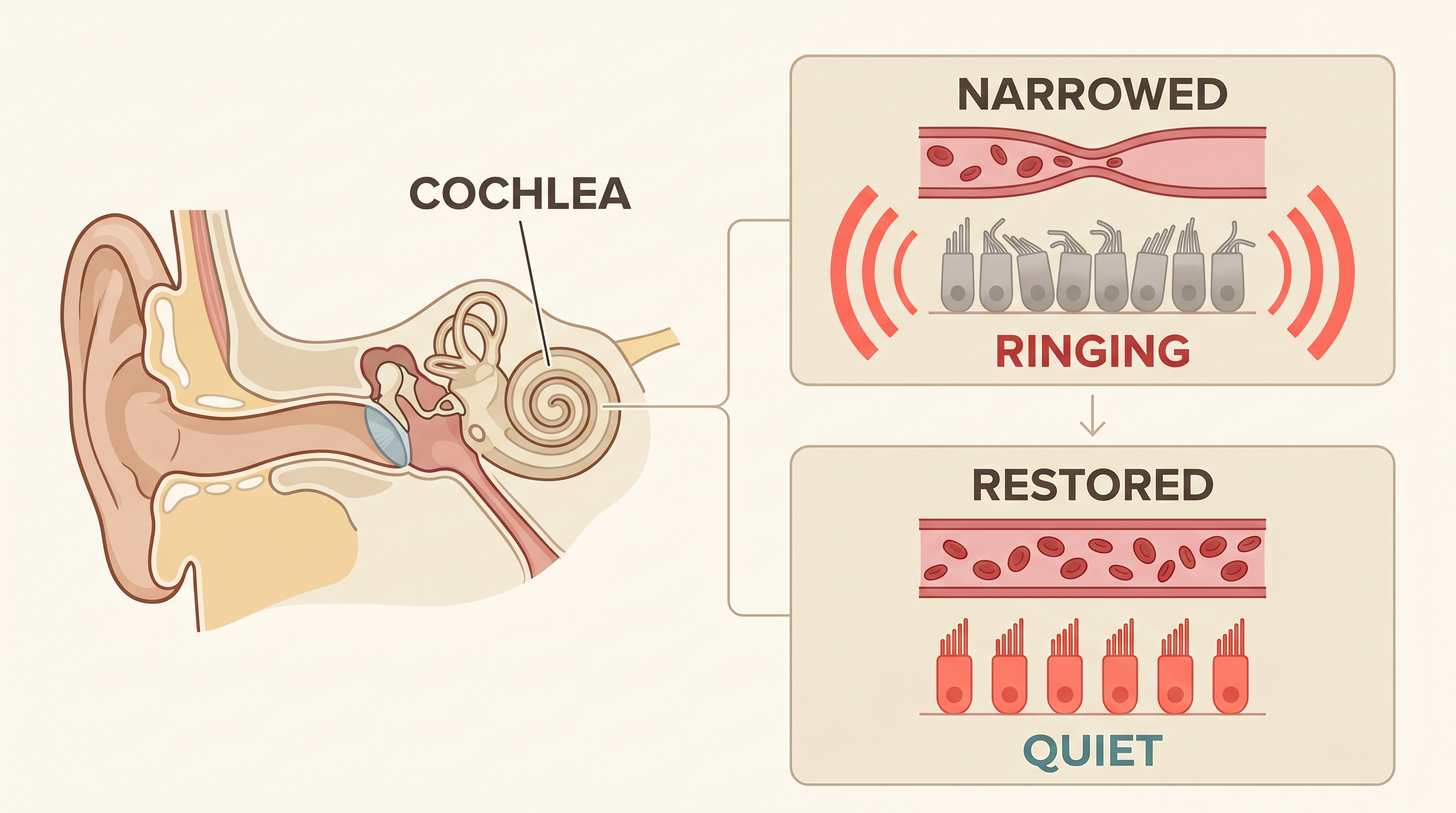
Here's what I didn't know after 22 years of practice. Your inner ear runs on capillaries thinner than a human hair. Aging slowly narrows them. The starved cells misfire. That's what you hear.
That's why white noise never worked for me. It covers the sound. But it doesn't reach the cells. You can't quiet a smoke alarm with a pillow.
French maritime pine bark is one of the few studied compounds that supports blood flow to those cells. In a 4-week clinical trial (Panminerva Medica, 2010), researchers measured:
- Cochlear blood flow rose 84%. So the cells finally had blood again.
- Tinnitus loudness dropped 45% on patient self-reports.
- Zero side effects.
I'd told a thousand patients to live with it. But then I read this. They didn't have to.
It's not covering the sound. It's feeding the cells that were starving.
It reaches the cells nothing else could
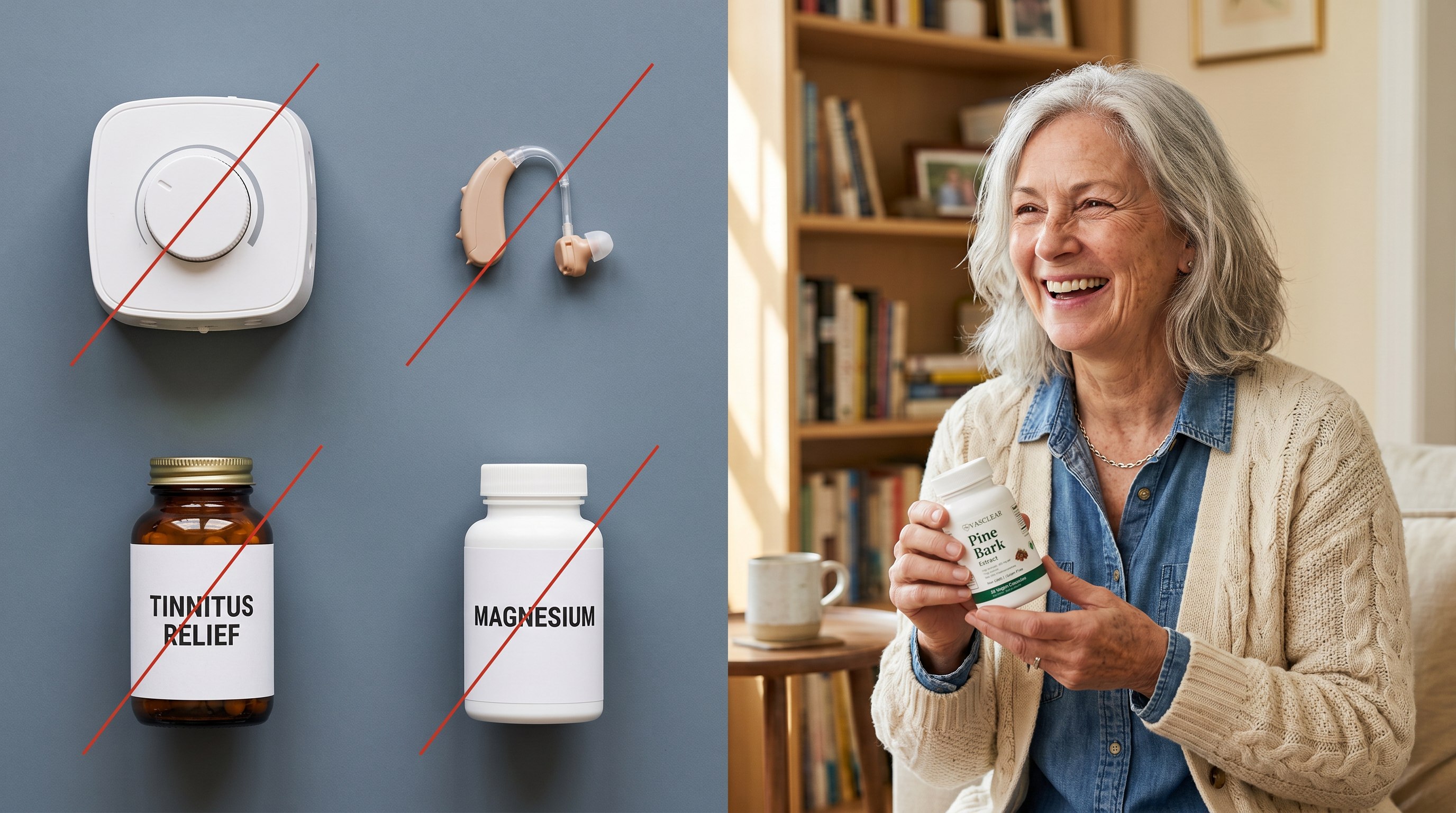
Once I understood the mechanism, everything my patients had tried made sense. None of them reached the cells.
- White noise. Rain sounds. A fan at night. They cover the ringing for a while. The moment the room gets quiet, the sound is still there.
- Hearing aids. They help you hear voices. The ringing keeps playing behind them.
- "Ear vitamins" like Lipo-Flavonoid. Built on a single 1960s case series. They promise ear support. For most people, the ringing never changes.
- Ginkgo and other "blood-flow pills." They support general circulation. The vessels in your inner ear are smaller than that.
- Magnesium, B12, zinc. Good general nutrients. Not built for the inner ear's supply problem.
- Meditation, breathing, CBT. They help you cope with the sound. They don't make it stop.
- "Learn to live with it." The hardest one to hear. Because it tells you quiet isn't coming back.
All of them work on the sound. None of them reach what's making it.
It feeds the brain, not just the ear
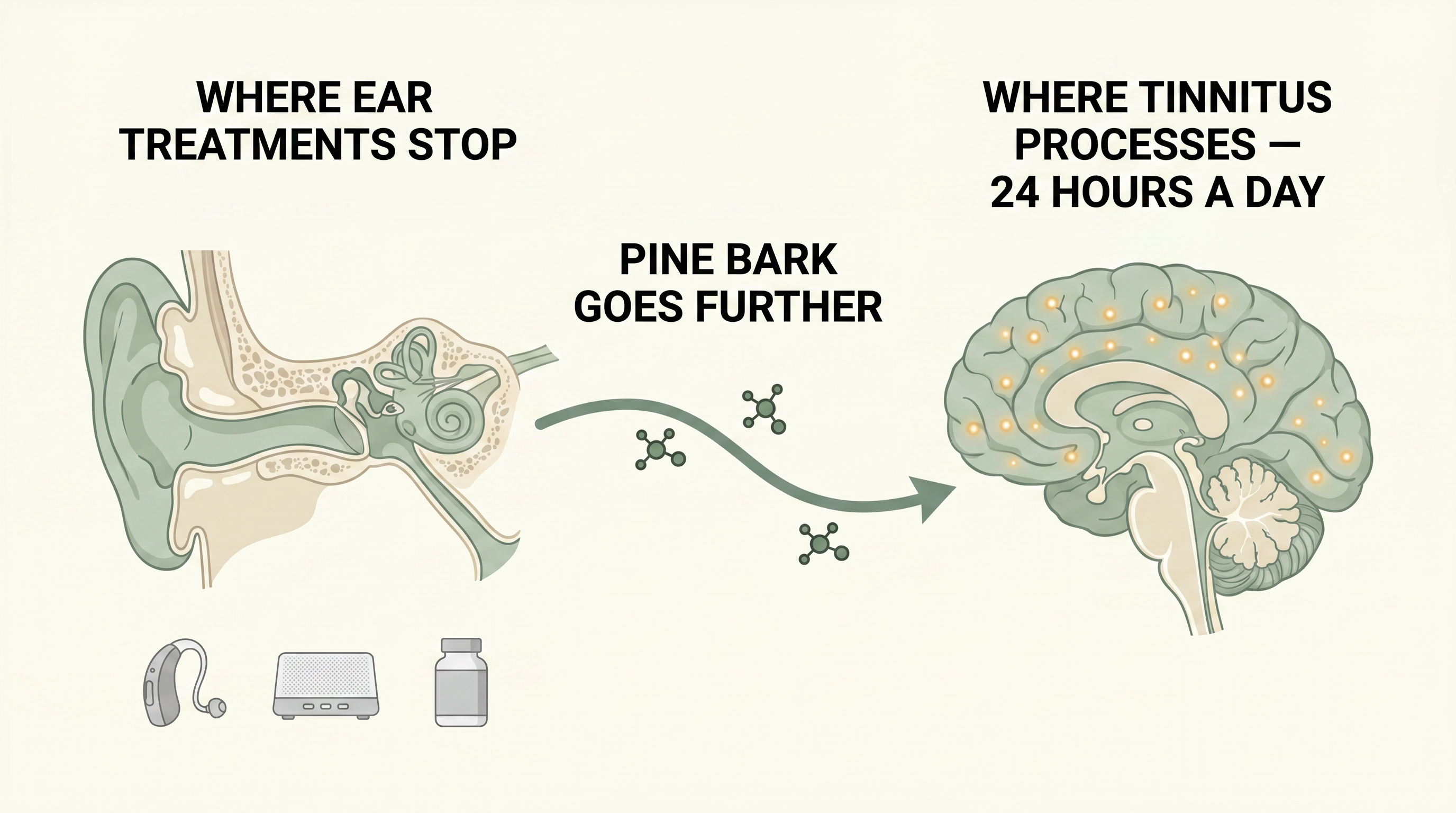
I'd missed this for 22 years. Tinnitus isn't just heard in the ear. It's also processed in the brain, 24 hours a day.
Even when you stop noticing the ringing, your brain doesn't. By 3 PM you're tired in a way you can't quite name. You read the same page three times and still don't remember it.
Your brain has a built-in filter that keeps almost everything out. But pine bark is one of the few studied compounds that gets through. So the brain that's been carrying the noise can finally rest.
In adults aged 60 to 85, 3 months of pine bark improved working memory (Journal of Psychopharmacology, 2008). The brain energy you'd been spending on the ringing got freed up. The less your brain fights it, the less you hear it.
I'd blamed my own afternoon fog on age. But it was the tinnitus all along.
The ringing was still there. But my brain stopped carrying it.
It addresses a bigger brain problem most people don't see coming
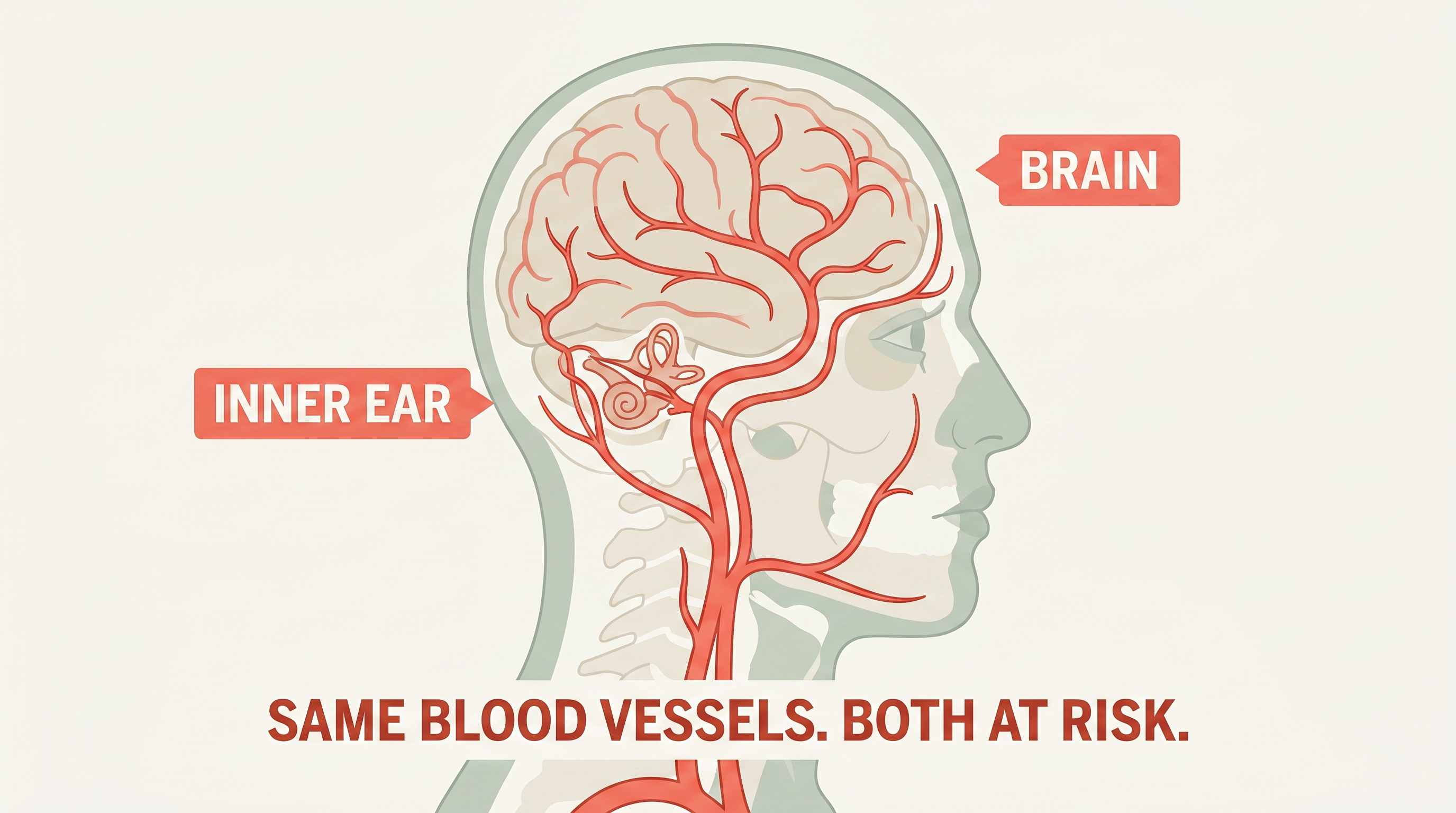
Here's the part that frightened me most as an audiologist. Adults with chronic tinnitus are around 1.5 times more likely to develop Alzheimer's.
That's not a coincidence. Think of it like the plumbing in an old house. The same pipes feed the kitchen and the upstairs bathroom. When the pressure drops, both rooms feel it. The ear is the first room to notice. The brain is the second.
Vascular aging doesn't pause. Waiting doesn't make it easier. Pine bark crosses your brain's protective filter and reaches those same vessels. In adults with vascular aging markers, 12 weeks of pine bark improved endothelial function by 66% (International Angiology, 2013).
The ear was the first room. The brain is the next.
It's backed by 160+ clinical trials over 40 years
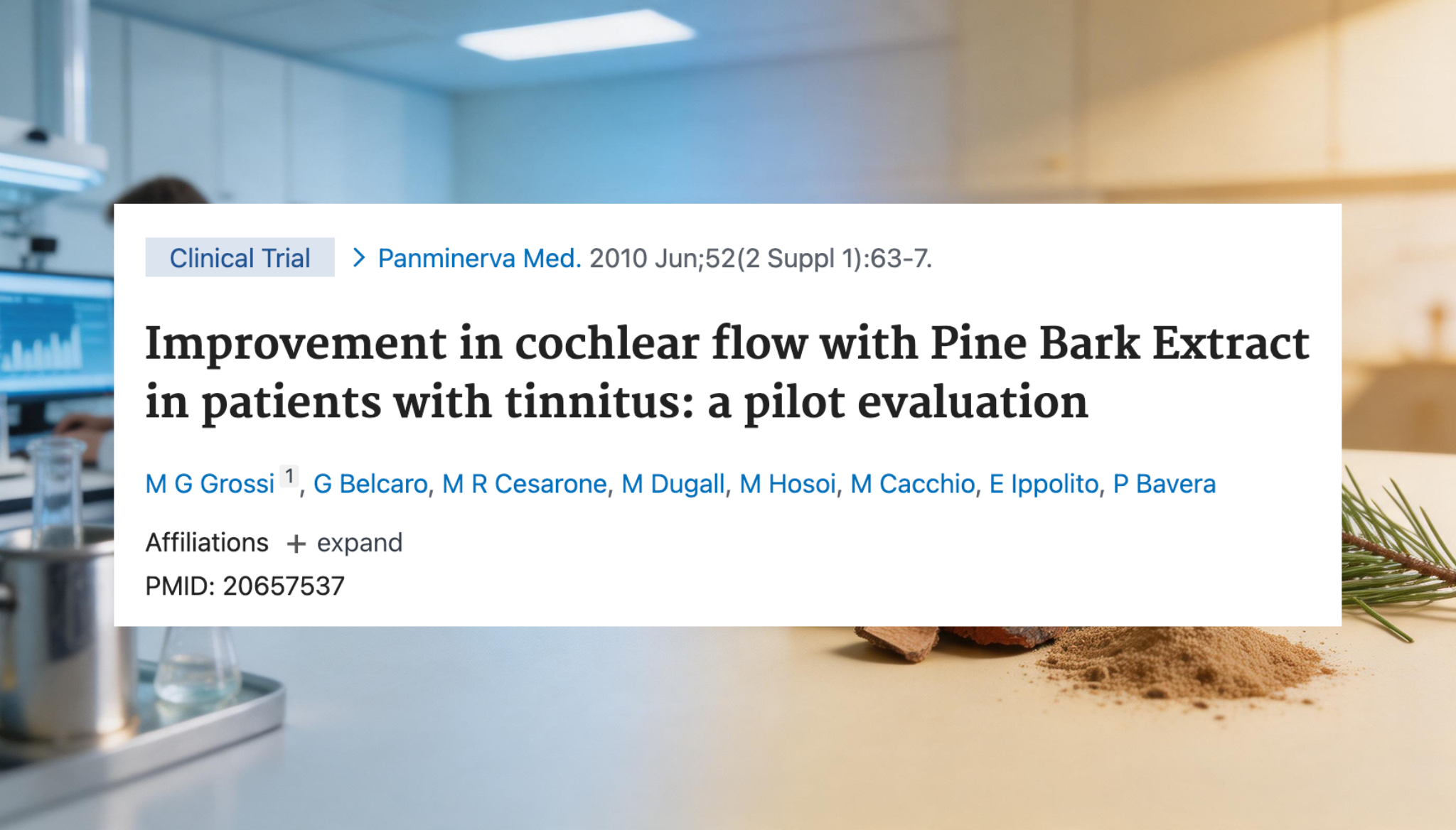
"Tree bark" sounded like supplement aisle nonsense to me too. Then I read the research.
- 160+ controlled clinical trials. Most "tinnitus supplements" on the shelf right now have zero peer-reviewed evidence.
- Over 24,000 patients. 40+ years of accumulated research data.
- Real medical journals. Panminerva Medica. Minerva Medica. European Heart Journal. Journal of Psychopharmacology.
- The Luzzi study. Patients with chronic tinnitus and inner-ear circulation problems took pine bark for 6 months. By month 6, 87% were fully symptom-free.
That's why I started taking it myself. The bottle I picked is Vasclear. Pure pine bark, nothing else mixed in, at 400mg per capsule.
It brings back the quiet hours you used to have

I want to be precise about what pine bark can and cannot do. There is no supplement on this earth that will give you back the silence you knew at 30. Any honest doctor who tells you otherwise should not have your trust.
There's the other direction too. Wait long enough and the ringing stops being the worst part. You snap at people you love. The grandkids stop asking. You lose words mid-sentence and blame the noise in the room.
The ringing isn't what your family notices first.
What you can have back is the life around the noise.
- You finish a novel. Not just start one.
- Music in the kitchen at 6 PM. The way you used to. Just music, not another layer of sound.
- The porch at dusk feels like the porch again. Not the volume on the ringing turning up.
- Sunday dinner at your daughter's. Kids loud, TV on. You stay through dessert. You catch the punchlines the first time.
- The people closest to you stop checking on you. They don't have to anymore.
The version of you who was already there.
You've spent decades taking care of everyone else.
Today, the smallest thing you can do for yourself is this. Less than your morning coffee.
Vasclear, French Maritime Pine Bark
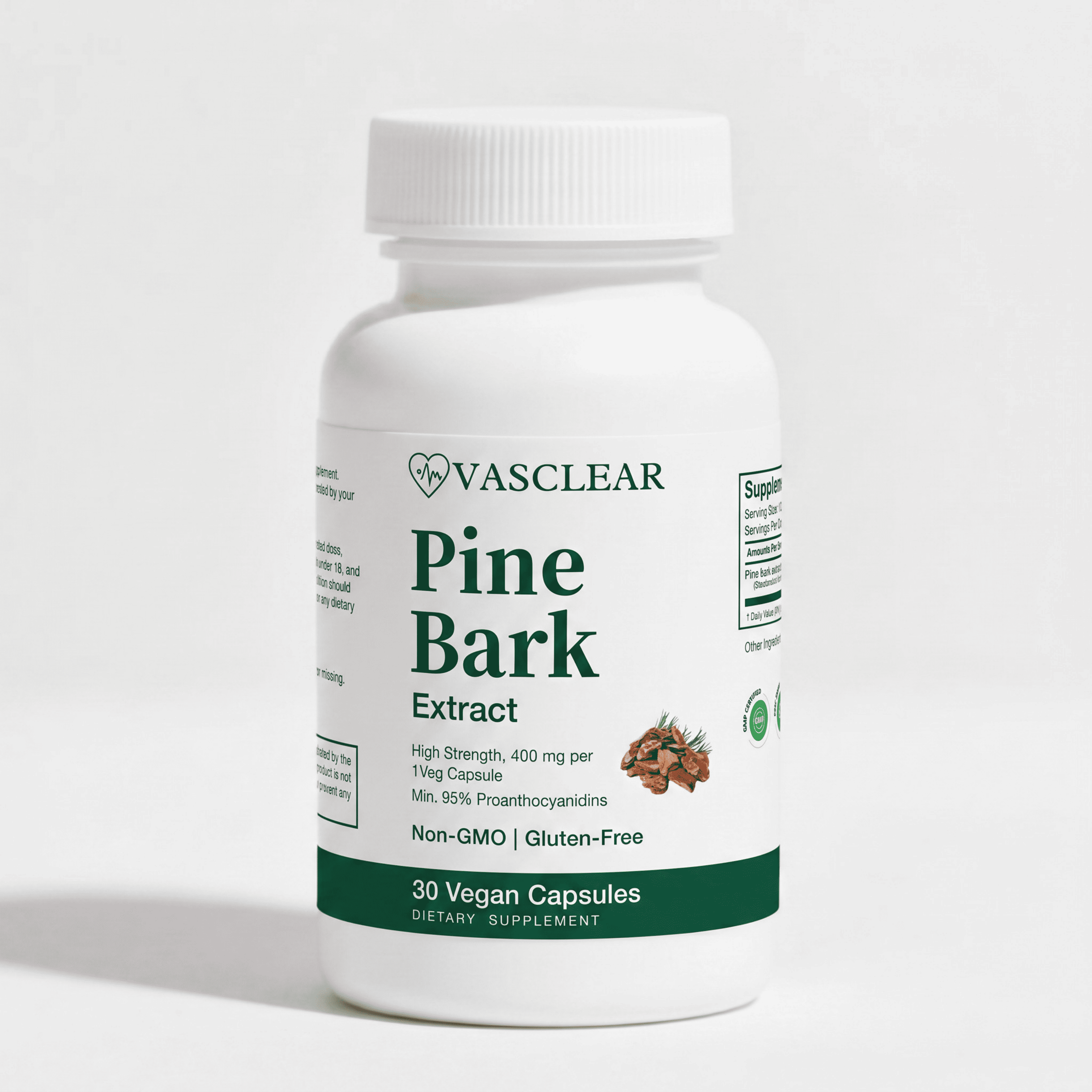
- 400mg high-potency French maritime pine bark
- 95% proanthocyanidins. The active compound the studies used.
- One ingredient. No fillers. No blends.
- Same form used in Grossi 2010, Luzzi 2014, Ryan 2008.
- Third-party tested for purity, every batch.
- 60-day money-back guarantee. Empty bottles accepted.
- Free shipping. Discreet packaging.
A second opinion from outside my specialty
I'm an audiologist. My specialty is hearing. But tinnitus also lives in the brain. So I sent the same research to a neurologist I trust. Here's what he wrote back.
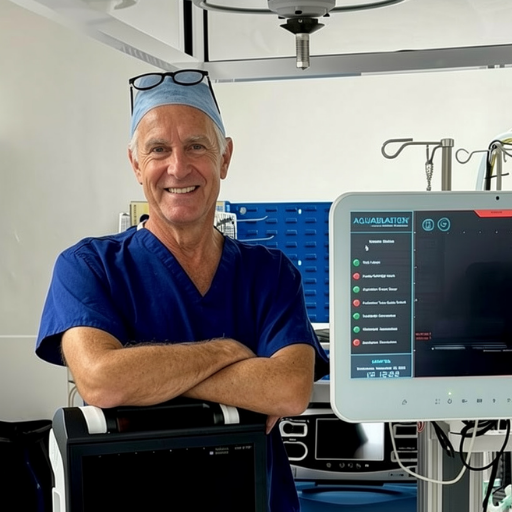
"In my practice I see adults with chronic tinnitus describe a daily mental tiredness their audiologist has no framework to address. French maritime pine bark is one of the few compounds with peer-reviewed human data on both inner-ear microcirculation and cognitive performance in older adults. The mechanism is real. I take it myself."
What the first 60 days look like
Nothing dramatic.
You take your first capsule with breakfast. You feel the same. That's normal. It's not caffeine. It builds up over time.
Your hands warm up.
Your hands feel warmer at night. A word you almost lost comes back to you. The ringing is still there. But when you're focused on something, you notice it less.
Three hours go by without thinking about it.
It's a Wednesday morning. You're loading the dishwasher and you realize you haven't thought about the ringing in three hours. You don't trust it yet. So you write the date on the kitchen calendar in pencil.
You finish a book.
First one in 2 years. That afternoon you go to your daughter's. You stay for dinner. She doesn't say anything. But she stops watching you the way she had been.
The audiogram is the same. Everything around it is different.
You sleep through the night. Your grandson tells you something and you catch it without asking him to repeat. The novel on your nightstand doesn't stay open to the same page for 3 weeks. Sundays feel like Sundays again.
If you don't feel a difference in 60 days, you pay nothing. No questions. Empty bottles accepted.
What other adults over 60 are saying




A few honest questions I get asked
No. I want to say this directly. What French maritime pine bark does, based on the published human data, is support the microcirculation that feeds the cells in your inner ear. It also supports the cognitive performance that gets taxed by the daily processing load of tinnitus. Both are measurable. Neither is a cure. They are daily mechanism support for a condition that does not currently have a cure in any specialty.
The published trials measured the first changes at 4 weeks (cochlear blood flow). The largest changes between months 3 and 6 (symptom reports). Honest answer: give it 8 weeks before you decide. The 60-day refund window exists for this reason. You have time to find out with no risk if it doesn't work.
Fair question. Three differences. One: those are proprietary blends. They won't tell you the dose of any individual ingredient. Vasclear has one ingredient at one dose, both listed on the label. Two: those don't publish trials on their formulation. Vasclear's formulation matches what was used in Grossi 2010, Luzzi 2014, and Ryan 2008. Pull them up yourself. Three: those run countdown timers and fake stock alerts. We've already told you we don't.
Audiogram results and tinnitus burden don't track. The studies in this article were run on patients with confirmed cochlear hypoperfusion and no clinically significant hearing loss. In other words, the patients whose audiogram came back "normal for your age."
The page is written for adults over 60 because that's the largest cohort in our customer base. But the Grossi 2010 trial was run on adults aged 35 to 55. The mechanism applies the moment vascular aging starts, which is earlier than most people think. If you're 50 with tinnitus, this is for you too.
Generic pine bark is usually 25 to 75 mg, not standardized to 95% proanthocyanidins, and almost never the specific French maritime variety used in the published research. Same compound name. Not the same research base.
That is the central point of this article. The studies were published in cardiovascular and general medicine journals, not in otolaryngology journals. Your ENT had no professional reason to encounter them.
If anything, French maritime pine bark works alongside most circulation-supporting routines your doctor has you on. It supports healthy microcirculation through the same vessels. A lot of our customers over 60 take Vasclear as part of their daily routine without issue.
In the Grossi 2010 trial, zero side effects were reported across all 82 participants. Same in Luzzi 2014. The most commonly reported sensation is feeling warmer in the hands and feet, which is the vascular mechanism working as it should.
Send an email to support. Empty bottles accepted. No survey, no "what could we have done better," no friction. We don't ask you to prove you tried. We trust that you did.
If you've read this far, you already know what to do next.
Vasclear has sold out 7 times in 18 months. Each time because press coverage moved faster than our manufacturing. The current batch is moving steadily. If the order button is active, we have stock. If we sell out, the next batch is 6 to 8 weeks behind.
Claim Reader Offer →Why you can't just buy generic pine bark
The supplement aisle doesn't separate generic pine bark from the standardized French maritime form that has the research behind it. Other extracts share the name. They don't share the data.
25–75mg per capsule. Rarely standardized. No third-party testing. No studies on this specific form.
Dose buried in a proprietary blend of 10–20 ingredients. None studied together. None at the clinical dose.
8 to 12 ingredients at sub-clinical doses, mixed into a proprietary blend. None publish trials on their formulation. If one of them worked, the data would exist.
400mg French maritime pine bark. Standardized to 95% proanthocyanidins. Single ingredient. Same form used in Grossi 2010, Luzzi 2014, and Ryan 2008. Third-party tested every batch.
Not sold in stores or on Amazon.
You already know where the standard road goes.
White noise machine. Tinnitus retraining therapy. A vagus nerve device. CBT. "Learn to live with it."
In 22 years, I've watched almost no one walk back from the end of that road.
For most of those 22 years I was telling people what their ENT just told them. Then it started happening to me. So I finally understood what my own specialty had been missing.
There is no cure for chronic tinnitus. I won't pretend otherwise. But there is a peer-reviewed, mechanism-based way to support the vessels and cells your standard workup never thought to check. For the specific kind of tinnitus most people over 60 have. The kind your ENT told you was "normal for your age."
You deserve a doctor who looks for what they were not trained to see. In the absence of one, you may have to look for it yourself.
Claim Reader Offer →I ordered my fourth bottle yesterday morning, before sitting down to finish this update.
— Dr. Marcus Reed, AuD
Board-Certified Audiologist
Diagnosed with idiopathic tinnitus at age 52. Symptom-managing, not symptom-free, at age 56.
The author received samples of the product discussed for evaluation. Editorial independence maintained throughout. Personal experience described reflects the author's individual journey and is not representative of typical results. Customer names in testimonials may have been changed for privacy.
Peer-reviewed sources: Grossi MG, et al. Panminerva Medica, 2010 · Luzzi R, et al. Minerva Medica, 2014 · Ryan J, et al. Journal of Psychopharmacology, 2008 · Cesarone MR, et al. Phytomedicine, 2010.
© 2026 Hearing & Cognitive Health Journal. All rights reserved.
What other readers are saying